Pedestrian Accident Claims: Evidence, Signals, and Witnesses
Pedestrian accident claims depend on preserving photographs, video, traffic-signal details, vehicle information, medical records, and witness accounts. Atlanta Auto Law reviews how each item supports the account of the collision and helps identify evidence that may need to be requested or preserved.
Request an EstimateWhat Information Should You Preserve After a Pedestrian Accident?
Pedestrian accident claims should preserve evidence that identifies the people and vehicles involved, shows the scene, records injuries, and captures what witnesses observed.
Preserve photographs of the collision scene, the crosswalk, roadway conditions, signs, and visible injuries. Save available video footage and write down vehicle identification details while they are fresh.
Keep medical records, discharge instructions, bills, and other injury documentation. Collect witness contact information and record what each witness personally observed without asking anyone to guess or change their account.
Atlanta Auto Law helps organize these materials so the claim file connects the physical evidence with the pedestrian's account, the driver's conduct, and the medical treatment.
How Traffic Signals and Witness Accounts Relate to Pedestrian Claims
Traffic signals and witness accounts help establish who had the right of way and whether the collision occurred consistently with the available scene evidence.
We review the vehicle signal, pedestrian signal, crosswalk markings, and the intersection layout. Signal phase information can help show which movement was permitted when the pedestrian entered the crosswalk.
A witness account may describe the driver's speed, position, turn, or statement after impact. Surveillance video can support or challenge those observations when the recording shows the relevant part of the intersection.
Right of way is evaluated with the full scene context. A signal dispute does not stand alone because the surrounding photographs, video, vehicle damage, and incident report may clarify what occurred.
What Evidence Can Show How the Collision Happened?
Collision evidence can show where the pedestrian and motor vehicle were positioned, how the impact occurred, and whether the accounts match the physical scene. We compare each item with the other available records before building the liability analysis.
The following evidence map explains the question each item may help answer.
| Evidence | Question it may help answer |
|---|---|
| Scene photographs | Where were the crosswalk, signals, vehicles, and roadway features located? |
| Vehicle damage | Where did contact occur, and what may the impact pattern show? |
| Skid marks | Did the vehicle brake, and where did braking appear to begin? |
| Roadway conditions | Could the road surface or markings have affected visibility or movement? |
| Lighting conditions | What could the driver and pedestrian see at the time? |
| Traffic camera | Does recorded footage show the signal phase, movements, or impact? |
| Incident report | What information did responding officers record about the collision? |
How We Organize Evidence for a Pedestrian Accident Claim
Our evidence-preservation process places each record in context before we evaluate the insurance claim. The goal is to protect liability evidence and connect it to the injuries and losses being claimed.
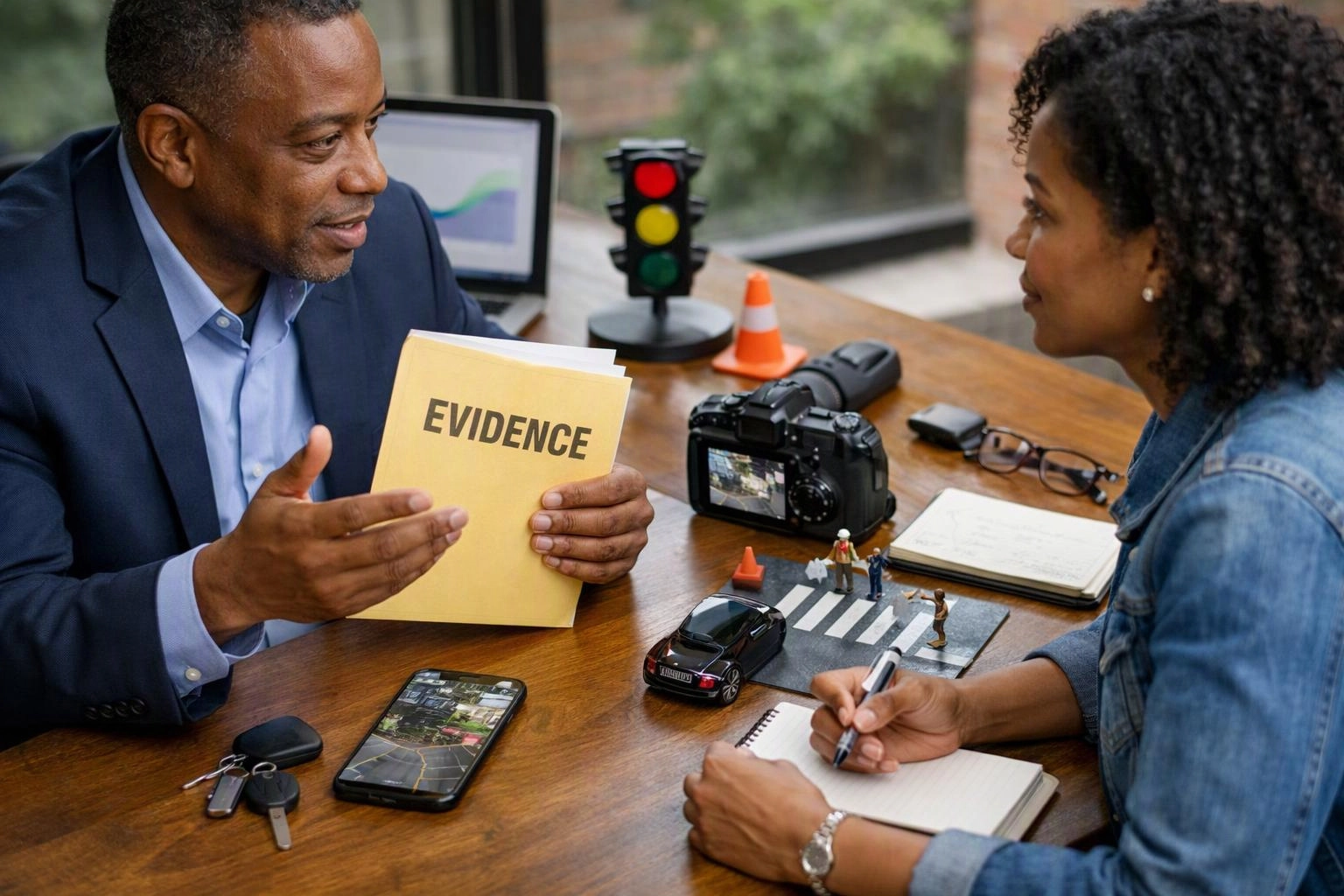
Our team uses the following process to develop a clear claim file.
What Should You Gather Before Discussing Your Claim?
Before discussing a pedestrian injury claim, gather records that identify the people involved, show the collision, and document the resulting harm. These materials give our team a clearer starting point for evidence review.
Keep original files when possible, and do not edit photographs or recordings. Place copies of related records together so important details are easier to locate.
How Atlanta Auto Law Reviews Pedestrian Accident Evidence
Atlanta Auto Law reviews a pedestrian accident claim by connecting the evidence to the disputed facts, the injury documentation, and the insurance carrier's position.
We compare the pedestrian's account with the driver statement, witness statement, photographs, reports, and traffic-signal evidence. Our team also checks whether surveillance footage or other records may support the account of the collision.
Our evidence review helps us identify gaps before we develop claim strategy. We use the organized file to explain liability, respond to disputes, and present the losses supported by the records.
To discuss Pedestrian Accident Claims, contact our team with the records you have preserved.
When Should You Preserve or Request Additional Evidence?
Additional evidence should be preserved or requested as soon as possible when the evidence may be overwritten, discarded, altered, or difficult to obtain later.
Potential sources include surveillance footage, traffic-camera footage, vehicle event data, the police report, and business records. We identify the record holder and make an evidence preservation request when the source may not retain the material indefinitely.
Prompt action also helps protect information about signal timing, vehicle condition, roadway conditions, and witness observations. A delay can make it harder to determine whether a recording existed or what it showed.
What Happens After the Evidence Is Organized?
After the evidence is organized, the claim is evaluated by connecting the collision facts to liability, injury documentation, and recoverable losses.
We assess whether the evidence supports driver negligence and whether comparative fault may become an issue. The analysis includes the pedestrian's actions, the driver's conduct, the right of way, and the available signal and witness evidence.
We then organize proof of bodily injury and damages, including medical treatment, medical bills, lost income, and other supported losses. The resulting claim file can guide an insurance claim and a settlement demand.
When you are ready to discuss your evidence, Atlanta Auto Law can review the claim and explain the next step. Contact our team to begin the conversation.
Questions About Pedestrian Accident Evidence
What photos should I take after being hit by a car as a pedestrian?
Photos should show the collision scene, crosswalk markings, traffic signals, vehicle damage, roadway condition, lighting condition, and visible injuries. Atlanta Auto Law reviews these images with the other evidence to determine what they may show about position, visibility, and impact.
Can a witness statement help prove a pedestrian accident claim?
Yes, a witness statement can help prove a pedestrian accident claim when the witness personally observed the signal, crosswalk movement, vehicle path, impact, or driver statement. The account is strongest when it can be compared with photographs, video, reports, and other liability evidence.
How can I preserve traffic-camera or surveillance footage after a pedestrian accident?
Preserve traffic-camera or surveillance footage by identifying the camera owner, recording its location, and making an evidence preservation request promptly. The request should identify the collision location and the relevant event so the record holder can locate the footage.
Should I give recorded information to an insurance adjuster after a pedestrian accident?
No recorded information should be provided without understanding the questions, the claim issues, and how the answers may be used. An insurance adjuster may ask for a statement before all medical and scene evidence is known, so discuss the request with our team before responding.
What if the driver disputes the pedestrian signal or right of way?
A disputed pedestrian signal or right of way should be tested against signal evidence, crosswalk markings, witness accounts, surveillance footage, photographs, and the incident report. The full evidence record may show whether the driver's account matches the physical scene.
Related Resources
Questions to Ask During a Personal Injury Attorney Consultation
Everything About ItHow Attorney-Client Communication Works in a Personal Injury Case
Everything About ItHow to Choose the Right Personal Injury Attorney for Your Case
Everything About ItComparative Fault and Responsibility in Personal Injury Claims